
car charger
165W PD3.1 Car Charger: A Powerhouse Charging Solution
In today’s fast-paced world, staying charged up is essential. The 165W PD3.1 Car Charger emerges as a powerhouse solution, offering unparalleled charging capabilities to keep up with your devices’ demands.
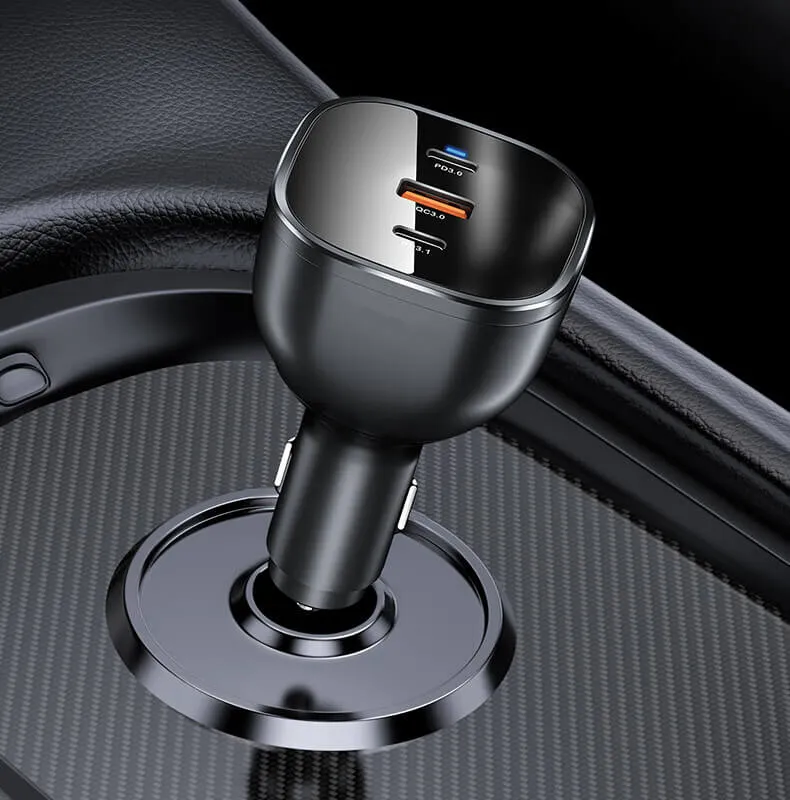
Dual 2C/1A Three-Port Output: Versatile and Efficient
The charger boasts a design featuring dual 2C/1A three-port output, ensuring compatibility with various devices. What sets it apart is its support for fast charging output across all ports, catering to the ever-growing need for speed and efficiency.
Unveiling the Product Protocol
Delving into its protocol reveals a robust compatibility range:
- USB-C1: PPS/PD3.1/PD3.0/PD2.0/QC3.0/QC2.0/DCP/AFC/FCP.
- USB-A: QC4.0/QC3.0/QC2.0/AFC/FCP/PE2.0/PE1.1.
- USB-C2: PPS/PD3.0/PD2.0/QC3.0/QC2.0/DCP/AFC/FCP.
This wide array of protocols ensures seamless connectivity across multiple devices, catering to diverse user needs.
Unmatched Power and Efficiency
The charger’s true prowess lies in its ability to output fast charging concurrently through dual ports, delivering an impressive maximum power of 165W. The specifications speak volumes:
- C1 Port: 140W output with a range of power profiles.
- C2 Port: 65W output catering to a spectrum of charging needs.
- A Port: 36W output, ensuring efficient charging for various devices.


Simultaneous Usage and Adaptability
The charger’s adaptability shines when multiple ports are utilized simultaneously:
- C1 and C2: 100W and 65W maximum power output respectively.
- C1 and A: 100W and 36W maximum power output respectively.
- A and C2: Reaching a maximum function of 5V5A.
- C1, C2, and A: C1 dominates with 100W, while A/C2 ports share 5V5A efficiently.


Reliability
1. High temperature storage test:
The test temperature is 70℃±2℃, and the continuous test time is 8h. After the test, after leaving it at room temperature for 2 hours, the electrical properties appear to be normal.
2. Low temperature storage test:
The test temperature is -40℃±3℃, and the continuous test time is 8h. After returning to normal temperature after the test, the electrical properties appear to be normal.
3. Drop test:
The test product is not packaged, and is dropped freely onto a wooden board from a plane with a height of 1m±0.1m, twice vertically and twice horizontally. Bumps are allowed on the appearance, but the structure should not be loose or damaged and should function normally.
4.Plug and pull test:
4.1 A port plug-in test
The plug and pull force is between 8-35N. After 5 plugs and pulls, the force is not less than 10N. After 1,500 plugs and pulls (500 times per hour), the force is not less than 8N. Plugs and sockets must pass 2,000 plug and pull tests. The appearance of the plug injection molded parts allows Despite wear and tear, the structure remains intact and the conductive performance is normal.
4.2 Type-C plug-in test
Insertion: 5N-20N, removal: 8N-20N (1-1000 times), 6N-20N (1001-10000 times). After the test, the mechanical structure of the product is not damaged and the function is normal.
4.3 Insertion and withdrawal force test of cigarette lighter holder
When the insertion and withdrawal rate does not exceed 12.5mm/min, the force required to fully insert the power adapter plug into the cigarette lighter is within 10-35N, and the force required to completely pull out the power adapter from the cigarette lighter socket is within 10-35N After being plugged and unplugged 2,000 times, the product structure is not damaged and functions normally.
5. Salt spray test:
The salt water concentration is 5%, spray continuously for 12 hours, and the temperature in the barrel is 35°C. After the test is completed, take out the specimen, wash off the adhering salt particles with clean water below 38°C as soon as possible, use a brush or sponge to remove other corrosion products, and use compressed air without oil mist to dry the specimen. And return to normal temperature (25±2℃) for 24h. Check the appearance of the charger to see that the exposed metal and electroplated parts are not rusty.
6. Over-temperature protection:
When the chip temperature exceeds 130°C, the output voltage begins to decrease; if the overtemperature continues to exceed 150°C, the chip enters over-temperature shutdown mode. After entering the over-temperature shutdown mode, the temperature drops below the over-temperature threshold, and the chip automatically powers on and returns to the default state.
7. Short circuit protection:
When inputting 12V-24V, the output should not be damaged after a short circuit; after the short circuit is removed, the normal output should be restored.
8. Output overvoltage protection:
This IC main chip has a built-in overvoltage protection function. When the output exceeds 15% of the normal voltage, the chip automatically activates the voltage reduction module to restore the voltage to the normal range, thereby protecting the mobile phone.

Enhanced Compatibility Features
Moreover, the charger supports BC1.2 DCP mode and is adept at recognizing Apple/Samsung high current charging modes, ensuring compatibility with a wide range of devices and manufacturers.
The 165W PD3.1 Car Charger stands as a testament to innovation and adaptability in the realm of charging solutions. Its multifaceted abilities cater to diverse charging needs, making it an ideal companion for users seeking reliable and efficient power delivery.
FAQs
Q: Can this charger be used with multiple devices simultaneously?
A: Absolutely! It’s designed to efficiently charge multiple devices simultaneously while allocating power optimally.
Q: Is this charger compatible with smartphones and laptops alike?
A: Yes, its versatile protocol ensures compatibility with various devices, including smartphones and laptops.
Q: How efficient is the charger when connected to different ports simultaneously?
A: The charger adapts intelligently, ensuring optimal power allocation even when multiple ports are in use.
Q: Does it support fast charging across all connected devices?
A: Yes, each port supports fast charging, delivering efficient and speedy power delivery to connected devices.
Q: Can it adjust power delivery based on device requirements?
A: Absolutely! The charger intelligently recognizes and adapts to different devices’ charging needs.
Q: Is it travel-friendly?
A: Certainly! Its compact design and versatile charging capabilities make it an excellent travel companion.
